
Why did God employ a fish to deliver Jonah? What’s with all the fish in the New Testament? I don’t know if you’ve noticed but there are a lot of fish in the Bible, and it’s worth pondering their symbolism.
Fish feature prominently in the stories of Jesus, but appear a similar number of times in the Hebrew Scriptures as well. Jonah is a big one, but there are fish throughout the creation story, featuring in Exodus as part of life in Egypt, in the book of Job, for example.
At Jewish New Year you will often see fish on the table representing this biblical promise:
“And the Lord will make you the head and not the tail; you shall be above only, and you shall not be beneath, if you obey the commandments of the Lord your God, which I command you today, being careful to do them.” (Deuteronomy 28:13)
In Judaism fish symbolize prosperity, blessing, and divine protection. They have come to represent the Torah, which sustains life just as water sustains fish. But the symbolism of fish really comes into its own in the New Testament.
The sign of Jonah
Many times fish symbolically pertain to God’s word going out to the nations. After the creation story, fish first appear in connection with Egypt, a Gentile nation with which God interacted many times through dreams, visitations, and the wonders of the Exodus story. Fish also play a big part, as we mentioned, in the book of Jonah — a book primarily concerned with a reluctant prophet charged with taking God’s message to Gentile pagans in Nineveh.
Have you ever wondered why the people of Nineveh accepted the story so very quickly? It seemed like this bloodthirsty nation of ISIS style savages suddenly did an almighty U-turn after Jonah gave his half-hearted call to repentance.
There’s a good reason.
It turns out that the ancient Assyrians of Mesopotamia revered a mythical character called Oannes. This amphibious figure was believed to come out from the mouth of a fish to bring instruction and knowledge from the gods.
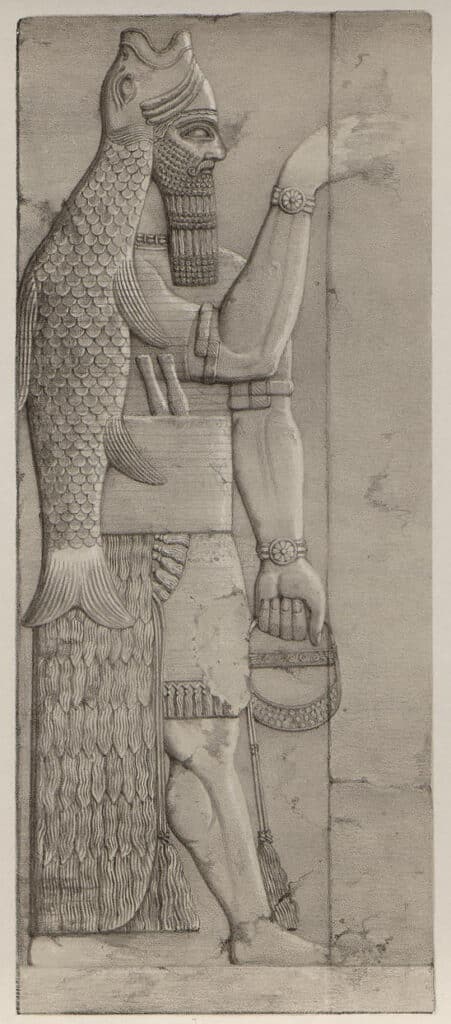
According to Encyclopaedia Britannica, Oannes had the head of a man under a fish’s head and human feet under his fish’s tail. The people of Nineveh believed Oannes emerged from the shores of the Persian Gulf to teach wisdom and civilization to mankind, so you can just imagine what they must have thought when Jonah appeared on the seashore clambering out of that whale to bring them a message from God!
Just as Peter found a coin in the mouth of a fish, great treasure came out of the mouth of a fish when Jonah made his unconventional entrance.
Yeshua pointed to the “sign of Jonah” when he was being quizzed by those who appointed themselves as the gatekeepers of God (Matthew 12:38–41). As Jonah was in the belly of the whale for three days and three nights, Yeshua rose again three days after His crucifixion to redeem the whole of mankind — not just the Jewish people. The message was to go to everyone.
As uncomfortable as it was for Jonah to go to Israel’s sworn enemies, and as uncomfortable for Peter when God told him the gospel was also for Gentiles in the same spot where Jonah tried to escape at Jaffa port, God insists that the Gospel is for the nations.
“Truly I understand that God shows no partiality, but in every nation anyone who fears him and does what is right is acceptable to him,” Peter acknowledged in Acts 10:34-35.
Multitudes of fish and the number 153
Whether it’s calling fishermen to leave their nets and become fishers of men, coins mysteriously appearing in the mouth of a fish, supernatural catches or the miraculous distribution to multitudes, fish are all over the place in the stories of Jesus.
Just after the resurrection the disciples had gone back to their previous vocation — catching fish. The fish kind, not the human kind. Here’s what happened on that wonderful morning:
Just as day was breaking, Jesus stood on the shore; yet the disciples did not know that it was Jesus. Jesus said to them, “Children, do you have any fish?” They answered him, “No.” He said to them, “Cast the net on the right side of the boat, and you will find some.” So they cast it, and now they were not able to haul it in, because of the quantity of fish….
When they got out on land, they saw a charcoal fire in place, with fish laid out on it, and bread. Jesus said to them, “Bring some of the fish that you have just caught.” So Simon Peter went aboard and hauled the net ashore, full of large fish, 153 of them. And although there were so many, the net was not torn. (John 21:4-11)
There are a couple of things to notice here. One is the fact that this is the second time it’s happened, but while the nets couldn’t cope with the huge weight of fish the first time, this time the nets did not break. The second is the number 153. Why did that specific number get included in the story?

There is something very interesting about that number 153 and the symbol of fish, discovered by the man who came up with the mathematical formula for pi (π).

More than 200 years before Yeshua was born, Archimedes linked the symbol of the fish with the number 153 in his calculations of the “Vesica Piscis” which means “the vessel of the fish.”
By drawing two circles overlapping to make an almond shape in the middle (the belly of the fish), Archimedes was able to figure out the geometry of that space within the intersection as being the square root of 3, or 265 ÷ 153, which is ≈1.732. This ratio is the starting point for other geometric figures and shapes.
With the two circles overlapping, some see it as the connection between heaven and earth, or the two aspects of Yeshua being fully God and fully man at the same time, and the prominence of the number 3 in Archimedes’ calculations adds to the reasons for connecting this Vesica Piscis to the trinity.1
Being a triangular number, 153 is also the total you get if you add the first 17 numbers: 1 + 2 + 3 + 4+ 5+ 6 + 7 + 8 + 9 + 10 + 11 + 12 +13 + 14 + 15 + 16 + 17, and there were 17 nations mentioned in Acts at the time of Pentecost.
These mathematical minutiae were not lost on the church fathers. St. Jerome back in the fourth century said that catching 153 fish symbolized gathering every type of person on earth, since at the time it was believed there were 153 types of fish. In both Hebrew and Greek gematria, the number 153 can equate to the phrase “Sons of God,” and St. Augustine believed that 153 represented all those who would be saved. Early Christians took it as a sign that the Gospel is intended to go to all nations.
The symbol of the fish
Fish became a symbol of faith in Yeshua as Messiah very early on. When believers were being persecuted in the first few centuries and they weren’t sure who was in the faith and who wasn’t, legend has it they would casually draw an arc in the dirt and see if the other person would finish the fish symbol by drawing another ark to complete it. Archimedes would probably be pleased to see that. The symbol came to symbolize the Messiah Himself, and belief in His deity.
Ichthys (ΙΧΘΥΣ) is an Ancient Greek word meaning fish, and the letters were used by early Christians as an acrostic:

It’s not by accident that the fish symbol ended up being the secret sign of the followers of Yeshua. It’s not so secret anymore, but the fish symbol is still quietly proclaiming His name.
And back to those nets in the miraculous catches of fish… The first time it happened, the disciples were not ready for the huge influx of fish and had to call others to come and help when the nets broke. The second time it happened, as the risen Lord was grilling breakfast for them on the beach, the nets were strong and ready, well connected and holding together. There were no holes, gaps, or weak connections. They held all 153 fish.
This is a perfect picture of our partnerships in the gospel as believers. If we work together as fishers of men, we are able to bring in huge hauls of fish from every people, tribe and tongue, both Jews and Gentiles. Are we revival ready?
- Fletcher, R. Musings on the Vesica Piscis. Nexus Netw J 6, 95–110 (2004). https://doi.org/10.1007/s00004-004-0021-8
Picture by Marek Studzinski on Unsplash