
There’s a famous encounter with a character the Bible describes as the Commander of the Lord’s Army in Joshua chapter 5. His message to Joshua was profound, and his identity even more so. However, there is another extremely important aspect which often gets missed, and that’s what happened next.
This is how the encounter went:
When Joshua was by Jericho, he lifted up his eyes and looked, and behold, a man was standing before him with his drawn sword in his hand.
And Joshua went to him and said to him, “Are you for us, or for our adversaries?” And he said, “No; but I am the commander of the army of the Lord. Now I have come.”
And Joshua fell on his face to the earth and worshiped and said to him, “What does my lord say to his servant?” And the commander of the Lord‘s army said to Joshua, “Take off your sandals from your feet, for the place where you are standing is holy.” And Joshua did so. (Joshua 5:13-15)
Who is the Commander of the Lord’s Army?
It’s a bit reminiscent of the burning bush episode experienced by Joshua’s predecessor. Moses met the Angel of the Lord in the desert where he was given the task of leading Israel as God delivered them out of Egypt, and here Joshua is receiving his own commission for the next stage of Israel’s journey from the Commander of the Lord’s Army. Both had to take off their shoes due to being in the presence of God.
Just as the Angel of the Lord, the Commander of the Lord’s Army shares the divine nature. Not only is Joshua standing on holy ground, but when Joshua worships the Commander of the Lord’s Army, instead of telling Joshua to worship God alone, as any ordinary angel would do, He accepts the worship. He is the pre-incarnate Messiah, Yeshua.

Decades previously, Moses was told at the Burning Bush:
“I have come down to deliver them out of the hand of the Egyptians and to bring them up out of that land to a good and broad land, a land flowing with milk and honey, to the place of the Canaanites, the Hittites, the Amorites, the Perizzites, the Hivites, and the Jebusites.” (Exodus 3:8)
And now here they are, at the threshold. The people of Israel had been delivered from Egypt and were now standing at the gate of the Promised Land. All those people groups were no longer just a list of names in a promise, they were a reality lying between Israel and the land.
Yet here was the Commander of the Lord’s army saying He wasn’t on either side. Interesting.
God’s promise and plan
Centuries earlier, even before they got to Egypt, God had laid the whole plan out to Abraham long in advance:
“Know for certain that your offspring will be sojourners in a land that is not theirs and will be servants there, and they will be afflicted for four hundred years. But I will bring judgment on the nation that they serve, and afterward they shall come out with great possessions. As for you, you shall go to your fathers in peace; you shall be buried in a good old age. And they shall come back here in the fourth generation, for the iniquity of the Amorites is not yet complete.” (Genesis 15:13-16)
Everything was going according to the schedule as God told Abraham, as excruciating as it was all round. There was a lot of suffering involved, but much to be gained. What was the plan exactly?
- Abraham’s descendants were to be afflicted in Egypt for 400 years
- God would bring them out with great possessions
- The Israelites would return to the Promised Land in the fourth generation
- The iniquity of the people in the land had to reach its full measure and be complete before they were ousted.
God gave those living in Canaan 400 years to correct their ways but they continued to sin until it reached its full measure. Now it was judgement day.
The plan included suffering but also great promises. God had consistently said that the Israelites were to conquer the land and take the inhabitants out. This sounds terrible to our twenty first century ears, but God is righteous. He is also very patient. He would not allow the sins committed for generations in the land to continue forever, and Israel was the tool He would use to accomplish His purposes.
The Lord your God will cut off before you the nations you are about to invade and dispossess. But when you have driven them out and settled in their land, and after they have been destroyed before you, be careful not to be ensnared by inquiring about their gods, saying, “How do these nations serve their gods? We will do the same.” You must not worship the Lord your God in their way, because in worshiping their gods, they do all kinds of detestable things the Lord hates. They even burn their sons and daughters in the fire as sacrifices to their gods. (Deuteronomy 12:29-31)
Much like Sodom and Gomorrah, the sins they were committing were horrific and many were innocent victims of their cruel practices. God does not allow suffering to continue unchecked, and now that Joshua led the Israelites to the Promised Land, time was up for the people of Canaan, just as He said over and over from Exodus onwards.
“When my angel goes before you and brings you to the Amorites and the Hittites and the Perizzites and the Canaanites, the Hivites and the Jebusites, and I blot them out, you shall not bow down to their gods nor serve them, nor do as they do, but you shall utterly overthrow them and break their pillars in pieces.” (Exodus 23:23-24)
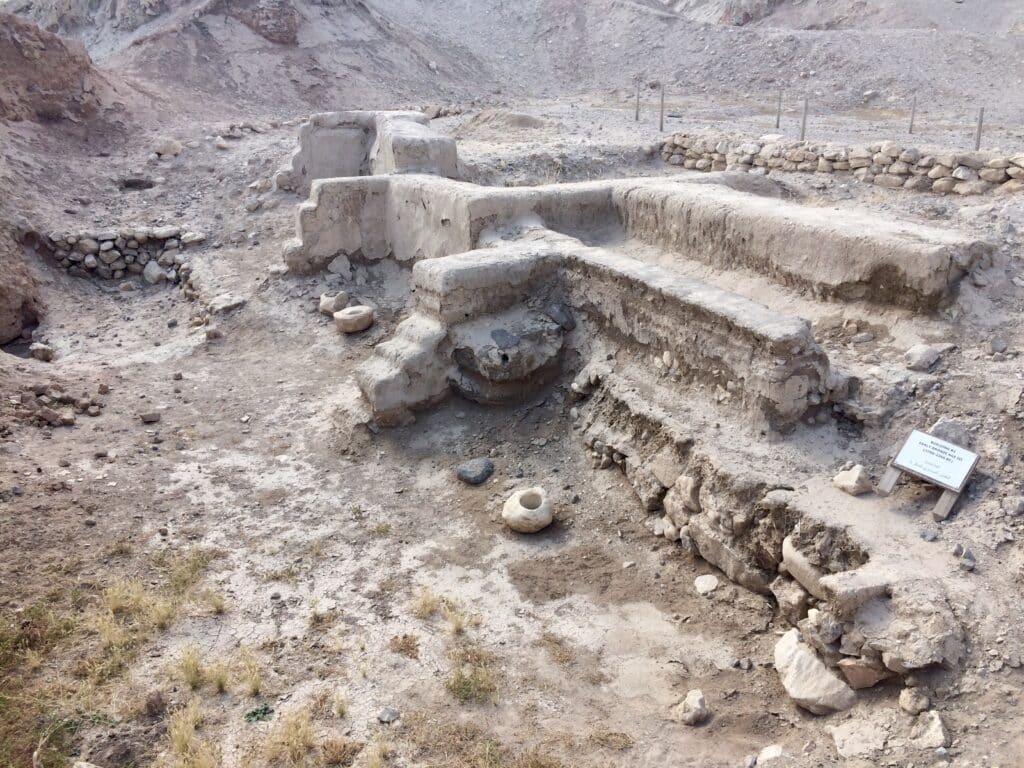
Yet 40 years before they got to that point, Joshua and his companion Caleb were two of the ten spies sent to check out the situation in the land. While Joshua and Caleb told of the great fruitfulness that lay within the land of milk and honey, the other ten came back with a terrifying report:
“And there we saw the Nephilim (the sons of Anak, who come from the Nephilim), and we seemed to ourselves like grasshoppers, and so we seemed to them!” (Numbers 13:33)
In other words, the people of the Land were way bigger than they were, and they despaired. But God’s intention was to bring an end to them.
It is in this context that the Commander of the Lord’s Army appears.
Whose side are you on?
When Joshua asks, “Are you for us or for our enemies?” the reply comes, “No.” While some take this statement to mean that God is not interested in war or sides, few seem to recognize what immediately follows this interaction.
The Commander of the Lord’s Army may not have favorites, but He does have plans and purposes.
What happens next is that He downloads what might be the world’s weirdest battle strategy: they were to take Jericho by circling it seven times and blowing the shofar.
Rahab and her family are saved, but no one else escapes. This same Commander that refused to take a side literally gave Joshua the winning battle plan.
“When the Lord your God brings you into the land that you are entering to take possession of it, and clears away many nations before you, the Hittites, the Girgashites, the Amorites, the Canaanites, the Perizzites, the Hivites, and the Jebusites, seven nations more numerous and mightier than you, and when the Lord your God gives them over to you, and you defeat them, then you must devote them to complete destruction. You shall make no covenant with them and show no mercy to them.” (Deuteronomy 7:1-2)
The Commander of the Lord’s Army may not be “for” Israel any more than for the people of Jericho, but He carries out His stated purpose of bringing an end to the people of the land. He is “for” righteousness, justice, and His own plan of redemption for all humanity. And yes, Israel was used to accomplish it.

The Hebrew for Commander of the Lord’s army is “Sar Tzeva Adonai” – captain of the army of the Lord, or the Lord’s host. It is from this that we get the idea of the Lord of Hosts, the Lord of angel armies. We often forget that God has entire legions of angels at His disposal — He doesn’t even need our help, He can fight enemies entirely by Himself. But you might have noticed that even though He may be doing all the heavy lifting, God nearly always chooses to use human beings, to work in partnership with us, because He is a relational God.
The destruction of Jericho was not pretty, but then neither were the centuries of sin that led up to it. God used Israel then and His purposes for Israel continue even today but His heart is for all the families of the earth. He is not on one side or another, the Commander of the Lord’s Army is fulfilling God’s own plans and purposes according to His word, but it’s not always going to look the way we think it should.
The question is, as God’s purposes are rolled out on the earth in the run up to the return of Yeshua, will you be on the Lord’s side?
Picture by Nik Shuliahin on Unsplash