In the run up to the fall feasts, the sixth month of the biblical year, Elul, is a time to turn back to God in repentance… and John the Baptist has a thing or two to say about that subject.
The holidays take place in the month of Tishrei, the seventh month according to the biblical calendar. The Feast of Trumpets is on the first of Tishrei followed by the Day of Atonement (Yom Kippur) on the 10th, and then at full moon, in the middle of the month, the week-long Feast of Tabernacles begins. Needless to say with all that feasting we don’t get much work done here in Israel in the month of Tishrei. “After the holidays,” is a term you constantly hear around that time of year.
But what about before the holidays? What is the preparatory month of Elul all about?
Preparation and repentance
Elul is the sixth month in the biblical year, and time to prepare for the “Ten Days of Awe” which begin on the first of Tishrei reaching their zenith at Yom Kippur on the tenth. Just as the Spring feasts speak prophetically about the death and resurrection of the Messiah in His first visitation, the Fall feasts are full of symbolism about His return. First comes the great trumpet sound (Feast of Trumpets), then the Day of Judgement (Yom Kippur), then God will dwell together with His people (Tabernacles). If this is the pattern, the time leading up to the return of the Messiah is prime time for us all to repent and get right with God.
“Therefore you also must be ready, for the Son of Man is coming at an hour you do not expect.” (Matthew 24:44)
The fact that the four Hebrew letters of “Elul” (אלול) are the first letters of “Ani LeDodi, VeDodi Li” – “I am my beloved’s and my beloved is mine”, from Song of Songs 6:3 has been highlighted as a reminder to turn away from sin and the world and into the embrace of our God who loves us.
Elul is considered a special time of drawing close to God, and He to us. In Israel, there are “selichot” prayers happening throughout the month, asking for forgiveness.
The message of John the Baptist with his call for repentance and announcing the arrival the Messiah is so appropriate:
“Repent, for the kingdom of heaven is at hand.” (Matthew 3:2)
It is said that “The King is in the Field,” in the month of Elul, meaning He has left His holy habitation to come near and live among us.
The spirit of Elijah
According to Matthew’s gospel, John the Baptist was the one spoken of by the prophet Isaiah when he said,
“A voice cries in the wilderness prepare the way of the Lord; make straight in the desert a highway for our God.” (Isaiah 40:3)
On one hand, the link between John the Baptist and Elijah is a bit of a biblical mystery. On the other hand, the links are manifold.
- The prophet Elijah lived a simple and solitary life in a dry and barren land, nourished by ravens.
- His name means “My God is Yahweh,” and he called the people of Israel to repentance, to turn back and worship the one true God.
- A powerful woman of the palace wanted his head.
- He was followed by a prophet greater than he, whose name means “God is Salvation.”
Elijah’s prayer for Israel was very short and simple:
“O Lord, God of Abraham, Isaac, and Israel, let it be known this day that you are God in Israel, and that I am your servant, and that I have done all these things at your word. Answer me, O Lord, answer me, that this people may know that you, O Lord, are God, and that you have turned their hearts back.” (1 Kings 18:36-37)
God won the contest that Elijah staged against Baal (obviously) and the people turned back to Him, which is less obvious an outcome. There is a monument at the top of Mount Carmel today where these events happened.
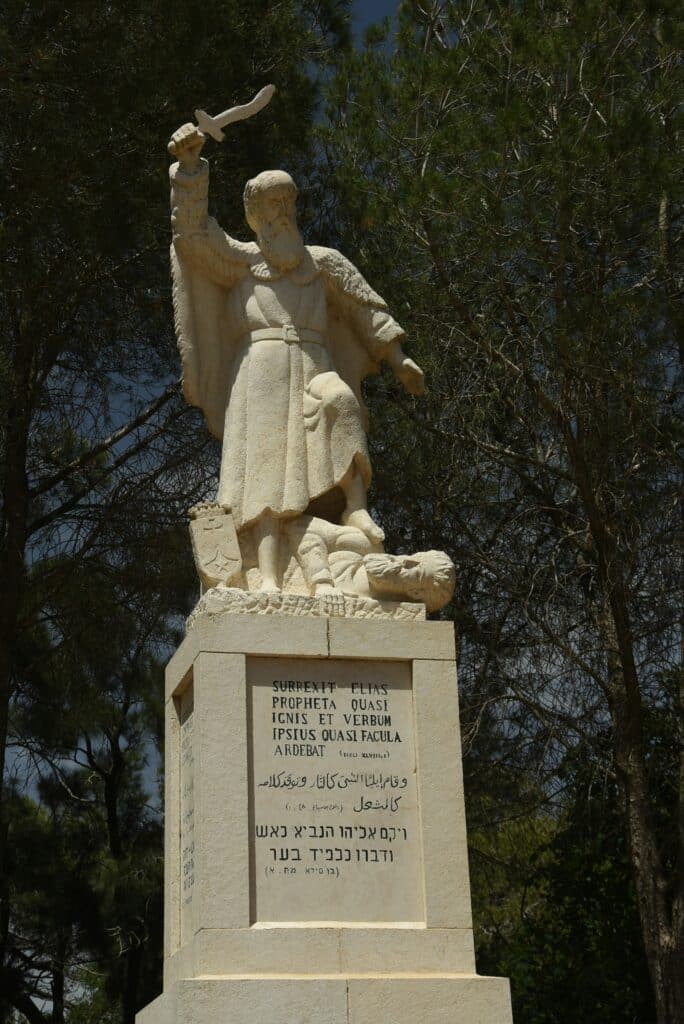
When Ahab’s wife Jezebel heard that the false prophets had been defeated, she was furious.
Then Jezebel sent a messenger to Elijah, saying, “So may the gods do to me and more also, if I do not make your life as the life of one of them by this time tomorrow.” (1 Kings 19:2)
However unlike John the Baptist, Elijah escaped the execution planned by the woman of the palace and went to meet God at Mount Horeb (Mount Sinai) where he was told about the next chapter, and his successor, Elisha.
Almost as if he had inherited that mantle of anointing, John the Baptist had several things in common with Elijah:
- John the Baptist was also an ascetic desert dweller with a strange diet.
- His name means “God is Gracious,” and he also called the people of Israel to repent.
- Instead of using swords he slew people with words from God, bringing stinging conviction. This landed him in a lot of trouble. So much so that Herod’s mistress demanded his head on a plate.
- He was followed by the Messiah, Yeshua, whose name means “Salvation.”
Prepare the way of the Lord!
While Elijah was a great prophet, his successor, Elisha (“My God is Salvation”) was even greater. Like someone else we know, Elisha miraculously multiplied food for disciples and did many other signs and wonders, rescuing widows, healing lepers, and even raising the dead.
Meanwhile, some 800 years later, John the Baptist made this promise about the One who would succeed him:
“I baptize you with water for repentance, but he who is coming after me is mightier than I, whose sandals I am not worthy to carry. He will baptize you with the Holy Spirit and fire.” (Matthew 3:11)

Yeshua (which means “salvation”) tells us that all the Prophets and the Law prophesied until John the Baptist, drawing the link explicitly:
“If you are willing to accept it, he is Elijah who is to come” (Matthew 11:14).
After John was beheaded for speaking the truth to Herod, Yeshua lamented,
“Elijah has already come, and they did not recognize him, but did to him whatever they pleased” (Matthew 17:12).
As the Day of the Lord comes closer, we all have the choice to prepare for His coming — to turn to Him, to get clean and get ready — or to ignore Him in rebellion.
Repentance is key
In Acts 3:19-21, Peter urges his fellow Jewish brothers and sisters in Jerusalem:
“Repent therefore, and turn again, that your sins may be blotted out, that times of refreshing may come from the presence of the Lord, and that he may send the Messiah appointed for you, Yeshua, whom heaven must receive until the time [season] for restoring all the things about which God spoke by the mouth of his holy prophets long ago.”
According to Peter’s words, several things are triggered into action when repentance occurs: First of all our sins are blotted out, so that we can experience times of refreshing from the Lord, then Yeshua returns from heaven to restore all things.
So in the spirit of Elijah and John the Baptist who followed him, we are also in a season of preparing the way of the Lord. Repentance must come first.
“If we confess our sin, he is faithful and just and will forgive us our sin, and cleanse us from all unrighteousness” (1 John 1:9)
He has assured us of total forgiveness when we confess our sin, and agree with him about it. This is an important step in being ready for the Lord’s return.
“He will go before him in the spirit and power of Elijah, to turn the hearts of the fathers to the children, and the disobedient to the wisdom of the just, to make ready for the Lord a people prepared.” (Luke 1:17)