A lot of Christians don’t realize that Pentecost is a Jewish holiday known as the Feast of Weeks, or Shavuot in Hebrew. Well — not Jewish so much as biblical — one of the feasts given to the Israelites by God in the Torah. Pentecost means 50th because it’s 50 days or seven weeks since the feast of Passover. But Pentecost feels very Christian to those who love Yeshua because it appears in the New Testament, shortly after some of the last instructions Yeshua gave on earth:
And while staying with them he ordered them not to depart from Jerusalem, but to wait for the promise of the Father, which, he said, “you heard from me; for John baptized with water, but you will be baptized with the Holy Spirit not many days from now.” (Acts 1:4-5)
When the Holy Spirit fell on the disciples ten days later as promised, it was right on the Feast of Weeks, Pentecost. They received power from God and went on to turn the world upside down. A third of the world, more or less, would describe themselves as “Christian” today, a fact attested to each time we write the date, recognizing the One who split time in two.
The pouring out of the Holy Spirit at Pentecost was absolutely key.
In fact, Yeshua told His disciples they would be even better off with the Holy Spirit than with Him in person:
“I tell you the truth: it is to your advantage that I go away, for if I do not go away, the Helper will not come to you. But if I go, I will send him to you.” (John 16:7)
How on earth could that be to their advantage?
The Holy Spirit is the Spirit of Yeshua, with us forever
The gift given that Pentecost was the presence of God in a way that could never be taken away. Yeshua promised them He would not leave them as orphans, but that He would ask the Father to give them “another Helper” to be with them forever, that Helper being the Spirit of truth who would actually dwell in the believer. Who is this Helper? The Holy Spirit is not some sort of impersonal force or power — according to Scripture the Holy Spirit can be grieved (Ephesians 4:30), He can be quenched (1 Thessalonians 5:19), and He can also be pleased (Acts 15:28).
The Holy Spirit has emotions, volition, and agency. He is, in fact, God.
And since Yeshua is God, the Holy Spirit is, as Paul later tells us (see Acts 16:7, Philippians 1:19, Galatians 4:6, Romans 8:9), the Spirit of Yeshua Himself. Instead of just leaving us to struggle on our own, the Holy Spirit gives us the power and help to live God’s way. Like a hand in a glove, we can live a life empowered by His Spirit.
“And I will ask the Father, and he will give you another Helper, to be with you forever, even the Spirit of truth, whom the world cannot receive, because it neither sees him nor knows him. You know him, for he dwells with you and will be in you. I will not leave you as orphans; I will come to you.” (John 14:16-18)
The word in Greek “another” (ἄλλος) means another of the same kind. Not just another one, but another of exactly the same kind. Our Comforter, our Helper, our Advocate, is just like Yeshua… living in us.
More than that the Holy Spirit gives us insight into God’s perspective. When He comes, we suddenly see ourselves how God sees us. We are sinful. We need salvation. Many don’t realize that fact until God graciously shows us. This is a work of the Holy Spirit.
And when he comes, he will convict the world concerning sin and righteousness and judgment: concerning sin, because they do not believe in me; concerning righteousness, because I go to the Father, and you will see me no longer; concerning judgment, because the ruler of this world is judged. (John 16:8-11)
The Holy Spirit also testifies that we are loved and adopted into God’s family:
“And because you are sons, God has sent the Spirit of his Son into our hearts, crying, ‘Abba! Father!'” (Galatians 4:6)
“For you did not receive a spirit that makes you a slave again to fear, but you received the Spirit of sonship. And by him we cry, ‘Abba, Father.'” (Romans 8:15)
Pentecost and adoption
It is very appropriate then that we read the book of Ruth at Pentecost, according to Jewish tradition.
When God commands the Pentecost celebration in Leviticus 23, He also gives in that same passage, connected to the theme of harvest, the instruction to leave the edges of the field for the poor to gather. It was thanks to this commandment that the Moabite Ruth was able to gather in the fields for her mother in law, Naomi and one thing led to another and she ended up married to Boaz, a rich Israelite from the tribe of Judah.
The story of Ruth is a picture of Gentile inclusion into the house of Israel that would be made possible by one of their descendants to come, the Messiah, Son of David. Not just getting the leftovers, but adopted and accepted as part of the family.

The resurrection and ascension of the Messiah and the outpouring of His Spirit on all flesh catapulted the faith of Abraham, Isaac and Jacob out to the nations. Before that moment our faith was firmly tethered to the land. Trudging through deserts, digging wells, building walls and fighting enemies… the story of Israel can be literally be found in the ground in archaeological digs. But once Yeshua sent His Spirit to live in the hearts of each believer, from that moment, our faith became airborne. Believers in Brazil or South Korea can live their lives without need of a temple since He lives within us all by His Spirit, anywhere in the world. By simply confessing our sins, receiving forgiveness, and asking the Father to be filled with His Spirit every day, anyone from any nation can live the abundant life Yeshua paid for.
Although Pentecost sent the Spirit out to the nations, we are nearing the time that Yeshua will come again in glory, the physical realities are lining up in readiness again: the land, the people, and the place are all being prepared like an airstrip made ready for a plane to land. Yeshua is coming back for His bride, and that bride is made up of every nation, tribe and tongue.
After this I looked, and behold, a great multitude that no one could number, from every nation, from all tribes and peoples and languages, standing before the throne and before the Lamb, clothed in white robes, with palm branches in their hands, and crying out with a loud voice, “Salvation belongs to our God who sits on the throne, and to the Lamb!” (Revelation 7:9-10)
Yet Yeshua says He will not return to Jerusalem until His own people call out to Him from there to welcome Him. It’s time for the Jewish people to be re-grafted back into the family tree.

Time for the Jewish people to be grafted back in
For the last 2000 years, the gospel has gone round the world, bringing salvation to all the families of the earth just as God promised Abraham. Gentile believers are like wild olive branches grafted into the original tree (Romans 11:17-24), but now it’s time for the people of Israel, the natural branches, to be included again too.
Today when Jewish communities celebrate Pentecost (Shavuot) the focus is on the giving of the Torah, since it is in the right timeframe after the Exodus that the Sinai event happened. But this connection back to the Sinai event was only made after the time of Yeshua. There is no sign of Shavuot being linked to Sinai in Jewish literature before the outpouring of the Holy Spirit in 33 AD. Luke, however, the author of the book of Acts, does make the connection, which means the first link between Shavuot and Sinai in Jewish literature is found in the New Testament. He may even have been the inspiration for the rabbinic tradition which came later.
Like the giving of the Law at Sinai, the giving of the Spirit at Pentecost was dramatic event on a significant mountain after a time of expectation involving fire, a mighty rushing wind, and a loud sound from heaven… 3,000 men, and the birth of a faith community.
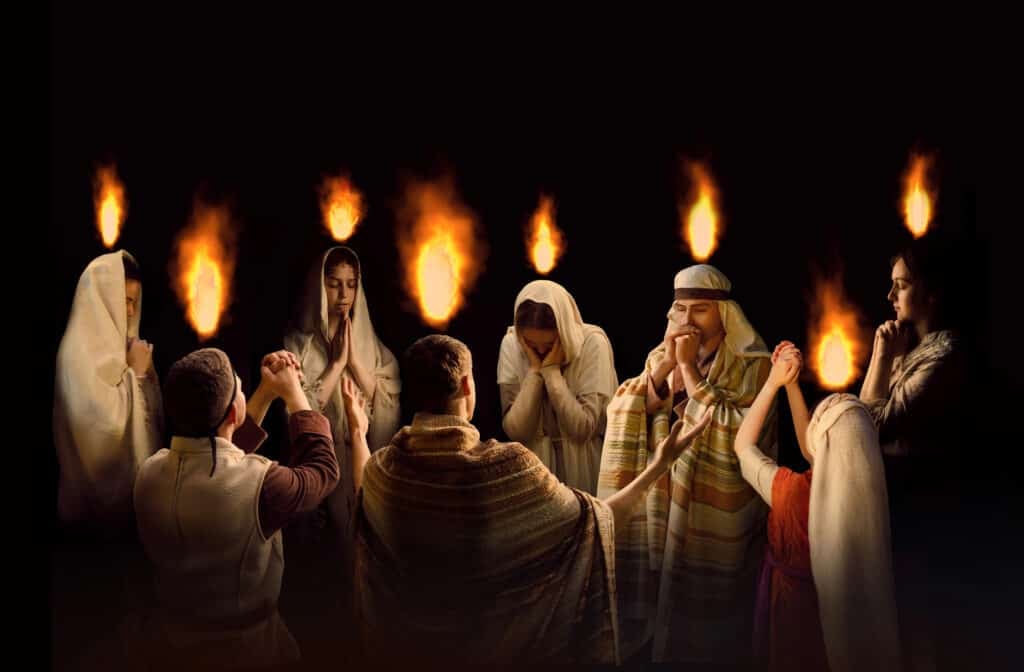
Though they may have been late to the party understanding that Pentecost related to the giving of the Law, the Sages got there eventually, and also understood that ultimately the word of God was for all nations, traditionally represented by the number 70.
“Each and every utterance that emerged from the mouth of the Almighty divided into seventy languages, a great host. And, similarly, the school of Rabbi Yishmael taught with regard to the verse: “Behold, is My word not like fire, declares the Lord, and like a hammer that shatters a rock?” (Jeremiah 23:29). Just as this hammer breaks a stone into several fragments, so too, each and every utterance that emerged from the mouth of the Holy One, Blessed be He, divided into seventy languages.” (Babylonian Talmud, Tractate Shabbat 88b)
Israel was chosen to be a kingdom of priests, entrusted with the oracles of God for the sake of the whole world. The Feast of Weeks, Pentecost, is the time when the Holy Spirit opened the way for the nations to come in. Now let’s pray for the Jewish people to receive a revelation of their Messiah. Let’s pray that the Spirit opens eyes to the need for salvation, to sin, righteousness and the judgment to come — that the people of Israel may come back to their own family home, back to the Father.
Main picture: Johannes Plenio on Unsplash