Have you noticed that trees seem very important in the Bible? Cedars, olive trees, palms and myrtles, for example crop up time and time again in important places. These are all evergreen trees, and I don’t think that’s coincidental.
The fact that Abraham planted a tamarisk tree caught my attention recently. Another evergreen tree.
“Abraham planted a tamarisk tree in Beersheba and called there on the name of the Lord, the Everlasting God.” (Genesis 21:33)
An evergreen tree planted in the place to call on the Everlasting God.

The trees used in the making of the temple, cedars and cypress trees, were also evergreens. The tabernacle and all its accoutrements, the ark of the covenant, the boards of the tent of meeting, the altar of incense, all made of acacia — another evergreen tree. Even musical instruments made for worship were crafted from evergreen trees — from fir wood, according to the biblical record:
“And David and all the house of Israel played before the LORD on all manner of instruments made of fir wood, even on harps, and on psalteries, and on timbrels, and on cornets, and on cymbals.” (2 Samuel 6:5)
Evergreen trees symbolize eternity.
Jeremiah 10 and tree-based idolatry
Around Christmas time fir trees pop up everywhere, decorated in houses for the holidays, and along with them the ongoing debate about paganism and idolatry. Jeremiah 10 is often wielded as evidence that evergreen trees like firs and pines should not be part of the festivities.
However, this passage is really talking about those who chop down trees and fashion the wood into idols, not about Christmas trees decorated in honor of the incarnation. See what you think:
Thus says the Lord:
“Learn not the way of the nations,
nor be dismayed at the signs of the heavens
because the nations are dismayed at them,
for the customs of the peoples are vanity.
A tree from the forest is cut down
and worked with an axe by the hands of a craftsman.
They decorate it with silver and gold;
they fasten it with hammer and nails
so that it cannot move.
Their idols are like scarecrows in a cucumber field,
and they cannot speak;
they have to be carried,
for they cannot walk.
Do not be afraid of them,
for they cannot do evil,
neither is it in them to do good.”
There is none like you, O Lord;
you are great, and your name is great in might.
Jeremiah is contrasting the Living God who can freely move and act with agency and might, unlike the dead carvings of man-made idols, created to be worshiped as if they had some kind of power to be feared. The prophet highlights the incapacity of an idol, a carved statue, to act or do anything at all — either good or evil.
Yet many faithful Christians who worship Yeshua, the promised Messiah, with carols, Bible readings, and nativity plays in His honor, also decorate an evergreen tree as part of their celebrations with no idolatry involved.1
The custom of bringing an evergreen tree inside as a Christmas decoration is a lot more Messiah-focussed than you might think.
You can see how the controversy creeps in though. Even nativity scenes depicting the biblical story can cause confusion. A believing family here in Israel set up a beautiful scene of the nativity with figurines made of olive wood (an evergreen tree, of course) which were then described as “idols” by unwitting secular Jewish visitors, trying to give a compliment. “Oooh I like your idols!” They exclaimed. My friends were horrified and made sure the nativity set was never seen again. These things can be misunderstood and misconstrued, but it doesn’t mean that my friends were actually worshiping idols! Heaven forbid.
The origin of Christmas trees
According to Encyclopedia Brittanica, the tradition started in the Middle Ages. Medieval Christians in Germany used a tree as a prop in biblical “Paradise play” plays to tell the story of creation, fall, and redemption at the Feast of Adam and Eve on December 24. They hung apples on what became known as “Paradise trees” to represent the tree of life that stood in the Garden of Eden, and wafers to symbolize the salvation that God brought through the Messiah, redeeming humanity.2
Wooden “Christmas pyramids,” were also used to display Christmas figurines, and were decorated with evergreen foliage, candles, and a star, and how paradise trees and Christmas pyramids eventually became what we know as Christmas trees today. Eventually Christians brought these trees into their homes on December 24 and added lights to symbolize the Messiah, Yeshua, the Light of the World, who came to earth to save us from sin.
Evergreen trees are very fitting since the entire story of the Paradise play was of God redeeming humanity from sin, so we can have everlasting life and never die.
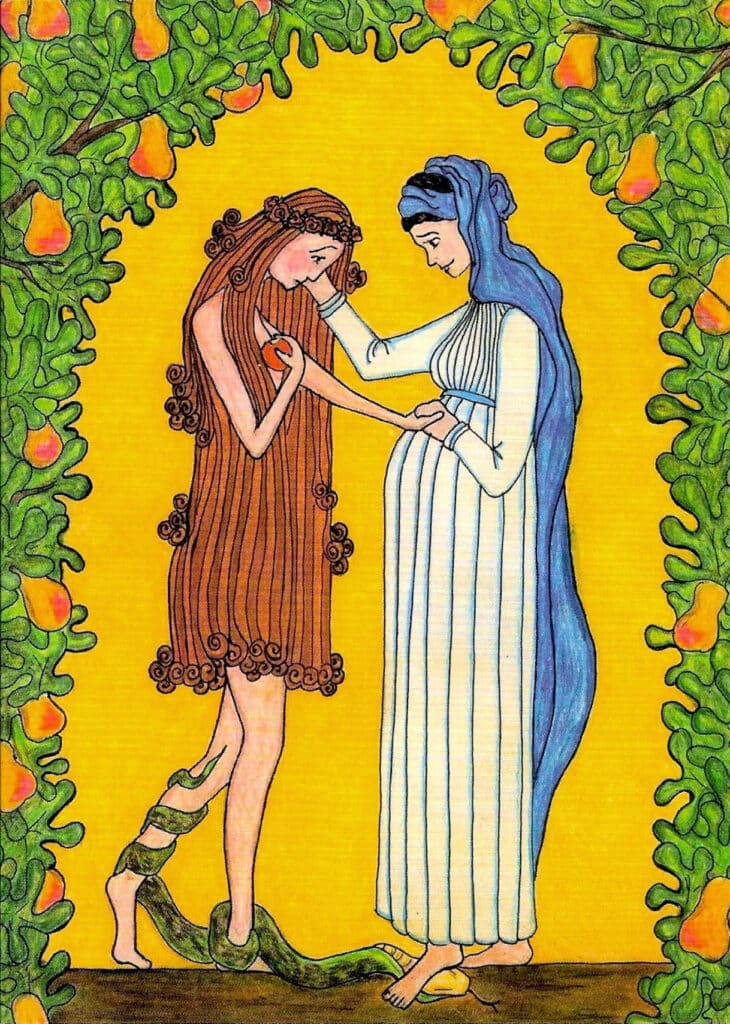
This beautiful artwork by Grace Remington shows the link between the stories of Eden and the incarnation: one bringing the fall of humanity, the other bringing the hope of restoration.
Hail the heaven-born Prince of Peace! Hail the Sun of Righteousness!
Light and life to all he brings, risen with healing in his wings.
Mild he lays his glory by, born that we no more may die,
born to raise us from the earth, born to give us second birth.
Various pines and firs that have been used to celebrate the incarnation throughout the years, including cypresses and cedars, all to decorate the holiday which celebrates the Messiah’s birth and the eternal life we can have as a result.
“What is striking about this origin story is how it intertwines the seasonal with the sacred. The tree, in its earliest forms, was a symbol of life and divine promise, standing in stark contrast to the barren, cold world outside. It was a symbol of hope and a reminder of light in the darkest time of the year. As people decorated their homes with these trees, they weren’t just marking the arrival of Christ; they were celebrating life,” wrote Matt Stone in his reflections on paradise plays.3
By the mid 1500’s the tradition had become so ubiquitous that there was an ordinance posted in Alsace, Germany, (1561) stating that households were limited to one Christmas tree each. German Lutherans continued the Christmas tree custom, and it was eventually made popular in England when German-born Prince Albert, husband of Queen Victoria, brought it to Britain in the nineteenth century, and the rest is history.
The tale of eternity in a tree
Trees are often used in the Bible to represent humanity in various ways. Thorns and thistles are a symbol of sinful humanity, while evergreen trees represent the upright. Fig trees represent Israel and oaks represent righteousness. The list goes on. The last verse of Isaiah 55 gives the contrast between briars and thorns with evergreen cypresses and myrtle trees, which stand for those who have received salvation and righteousness leading to everlasting life:
Instead of the thorn shall come up the cypress;
instead of the brier shall come up the myrtle;
and it shall make a name for the Lord,
an everlasting sign that shall not be cut off.
(Isaiah 55:13)
God also likens Himself to an evergreen tree, as He speaks through the prophet Hosea, calling idolatrous Israel back to Himself:
O Ephraim, what have I to do with idols?
It is I who answer and look after you.
I am like an evergreen cypress;
from me comes your fruit.
Whoever is wise, let him understand these things;
whoever is discerning, let him know them;
for the ways of the Lord are right,
and the upright walk in them,
but transgressors stumble in them.
(Hosea 14:8-9)

Although we may not be carving idols out of wood and stone today, the truth is that idolatry still thrives — not in Christmas trees so much, but whatever steals our affections and trust away from God. Whether it’s money, a good career, or over dependance on people for things that should only come from God, we need to also check our hearts to make sure we are making God our top priority, and worshiping Him alone.
As the One who gave up everything for us, who suffered and died in our place to give us eternal life, He deserves first place in our hearts. God is faithful, and promises never to leave us, and always look after us. His promises are eternal and His love endures forever.
“There is none like God, O Jeshurun,
who rides through the heavens to your help,
through the skies in his majesty.
The eternal God is your dwelling place,
and underneath are the everlasting arms.”
(Deuteronomy 33:26-27)