Keeping the Sabbath has become a topic of discussion again in Christian circles, partly due to a book written by the hugely influential Charlie Kirk: “Stop, in the Name of God: Why Honoring the Sabbath Will Transform Your Life.” Charlie Kirk had just finished writing the book before he was killed, and it has since been released, opening the subject up to the world in a new way.
More than that, new research has proved that keeping the Sabbath (or Shabbat as we say in Hebrew) has profound health benefits for Jews and Gentiles alike.
Research confirms it: we all need Sabbath rest
BioMed Central (BMC) conducted research to investigate “whether Jewish religious lifestyle, particularly Sabbath observance, affects habitual sleep–wake patterns in late adulthood.” They found that the practice of keeping the Sabbath contributed to a general improvement mental health, better sleep and less fatigue during the week, regardless of whether people believed in God or not.1
The rest and connection with other people that comes with keeping the Sabbath actually strengthens our immune system, reducing anxiety and depression, and leading to better quality of sleep and more regulated emotions, according to the report.2
In his book, Kirk explains his conviction, backed up by research, that keeping the Sabbath is key to a healthier lifestyle for individuals and families. He began turning off his devices and focusing on relaxing with his family each week, carving out proper downtime away from his demanding schedule. After seeing the positive impact on his life, he wanted to encourage others to do the same.
“It’s very simple: For one day, you will stop, that it will be holy, that it will be different.” Charlie Kirk told the crowd at a Turning Point event in January.
“People that honor the Sabbath live longer… they actually are happier, they have better health outcomes.”
“Every Friday night, I keep a Jewish Sabbath. I turn off my phone, Friday night to Saturday night. The world cannot reach me, and I get nothing from the world. It will bless you infinitely,” Kirk told his audience. “Everything about disconnecting from modernity is good from you. It is inarguable. This is this is a material fact, but why is that we have forgotten? Well, for me personally, I work like crazy for six days, on Friday night to Sunday morning, I turn my phone off, and I try to stop, I try to make it distinct, I try to make it different. That’s where I do my best thinking,” he explained.
“In this hyper materialistic, very fast, digitally frenzied world, there is this gift that I believe the Lord gave the Hebrews, that we have decided that this gloss over,” he said, opening up the secrets of the Sabbath to the world.
The mind and body begin a process of healing when given the chance to recharge, and stay in a constant state of vigilance and survival if not. We were not designed to be on-the-go 24/7, with our brains constantly whirring. This is what leads our nervous system to burn out. The practice of keeping Shabbat, downing tools for a good 24 hour period, signals to the body that it is safe to relax and switch into restoration mode. We all need to stop and reset — God designed us this way.
Friday night shabbat meals
In the Genesis account, the Sabbath day comes at the end of the week and is as part of the created order, operating like a reset button before a new week starts. The commandment to rest gives us the luxury of being unproductive for a while, which is essential for our physical renewal and mental restoration. The Shabbat gives invaluable space and unhurried time to reconnect with ourselves, our loved ones, and with God.
Many Christians see Sunday as the new Shabbat (since Yeshua rose again on the first day of the week, which was Sunday) but the first believers rested on the Sabbath and also worshiped together on Sunday. Why not do both?!
While Christians may be familiar with the idea of a day off as part of the weekly routine, the Jewish tradition of a family meal on Friday night is hardwired into the culture. This is not merely a cultural peculiarity, but an important part of Shabbat rest. And there are good reasons why.
There are good reasons to start the Sabbath on Friday evening rather than Saturday morning,
…and also why it’s good to kick off the Sabbath with a ceremony of sorts.
1) First of all, the idea of starting the day at sundown rather than sunrise might seem odd, but it’s actually biblical. The creation account repeats the phrase “and there was evening and there was morning…” indicating that the evening comes first. Secondly we see in Psalm 55 that a complete day starts in the evening:
“But I call to God, and the Lord will save me. Evening and morning and at noon I utter my complaint and moan, and he hears my voice.” (Psalm 55:16-17)
2) Secondly, by marking the beginning of a set time of rest with a ritual, the mind and body recognizes the signal to rest. In Jewish tradition, the Shabbat starts with the lighting of candles on a Friday night, and a family meal together. The “kiddush” begins, as traditional prayers are read, including the passage about Sabbath from the Creation story:
And there was evening and there was morning, the sixth day. Thus the heavens and the earth were finished, and all the host of them. And on the seventh day God finished his work that he had done, and he rested on the seventh day from all his work that he had done. So God blessed the seventh day and made it holy, because on it God rested from all his work that he had done in creation. (Genesis 2:1-3)
Just the sound of those words from Genesis being read on Friday night clicks my whole being into “Shabbat mode”. It’s the signal we can all exhale and relax.
I have a friend who invites everyone around the table on Friday night to “take a deep breath” to signify the start of the Sabbath as a habit. The Friday night meal with a special time of blessing and remembering God is a great way to enter into His Sabbath rest.
Two candles are lit, one for each time the Ten Commandments instruct us concerning the Sabbath. In Exodus 20:8 we are told to remember (זָכוֹר) the Sabbath, and how God made it as part of the created order, and in Deuteronomy 5 where the list is repeated, we are told to keep it (שָׁמוֹר), like a treasure. It’s a sign of our covenant with God who rescued Israel from Egypt: we are no longer slaves.
Many Jewish families also take this opportunity to sing together, for example Psalm 23 (the Lord is my Shepherd), and Proverbs 31, which praises the woman of the household. It’s traditional for the father to lay his hands on each child and bless them, praying over them a few short words, and the children look forward to it each week. It’s a great time to talk together and catch up on what’s been happening, and to enjoy one another’s company.
The specific rituals of Judaism are not necessary to experience the neurological benefits of a sabbath rest, but researchers found that connecting with family and community like this has observable health benefits, together with the sense of meaning that it brings. Additionally, the Friday night meal with the blessings that come before it are a perfect way to create that signal to our minds and bodies: “You are now entering the Sabbath.”
The bread and the wine
A key component of the Friday evening meal is the bread and the wine. Of course, these were staples back in the day, yet still represented bounty. Today Jewish families traditionally have sweet and delicious “challah” bread and wine or “tirosh” grape juice.
After the passage from Genesis describing the creation of the Sabbath is read, the bread and the wine are blessed:
“Blessed are you O Lord our God, King of the Universe, who creates the fruit of the vine.”
“Blessed are you O Lord our God, King of the Universe, who brings forth bread from the earth,” and in many Messianic circles we add “… and Yeshua from the grave!”
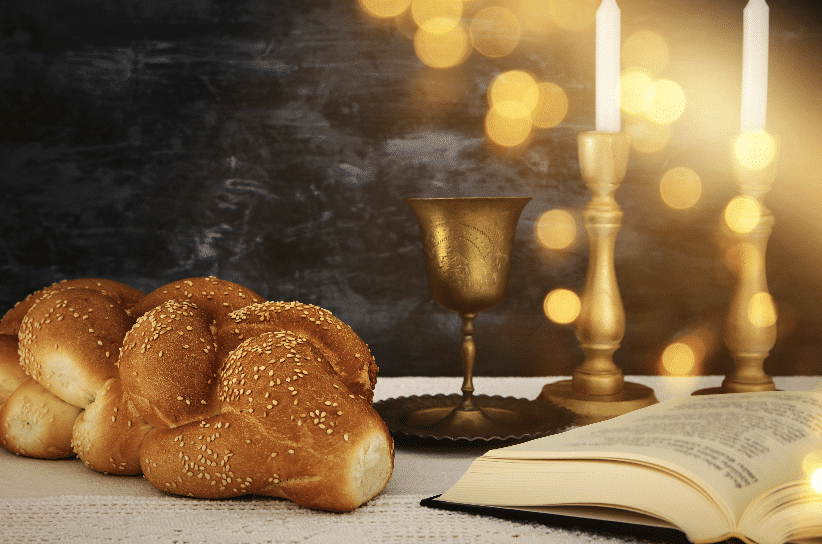
The cup is passed around the table, and the bread is broken, with salt added to it to remind us of the covenant of salt, with the table representing the altar of sacrifice. If this all sounds somewhat familiar to you as a disciple of Yeshua, wait till you hear this…
In the “sidur” prayer book, just after the Genesis passage and before the bread and the wine are blessed, comes this Aramaic phrase: “Sabri maranan!” Sabri means, “Consider” or “pay attention.” Maranan means “our lords.” You may be familiar with another Aramaic word “maranatha” mentioned in 1 Corinthians 16:22. Maranatha (ܡܪܢܐ ܬܐ, Marana tha or Maran atha) means “Our Lord, come!” You can see the word maran (Lord) there, which is the singular of maranan (lords). Could it be that “Sabri maranan” was originally “Sabri Maran”: “Consider our Lord”?
“The Lord Jesus on the night when he was betrayed took bread, and when he had given thanks, he broke it, and said, “This is my body, which is for you. Do this in remembrance of me.” In the same way also he took the cup, after supper, saying, “This cup is the new covenant in my blood. Do this, as often as you drink it, in remembrance of me.” For as often as you eat this bread and drink the cup, you proclaim the Lord’s death until he comes.” (1 Corinthians 11:23b-26)
It wouldn’t be the first time that the traditions of the first believers influenced Jewish liturgy. It is now well established, even in secular historical research, that the Passover seder is full of Messianic symbolism. The Didache, the Teaching of the Twelve Apostles, which is a sort of handbook to the Messianic faith from the first century, also includes the saying: “Let grace come, and let this world pass away. Hosanna to the Son of David. If any one is holy let him come (to the Eucharist); if any one is not, let him repent. Maranatha. Amen” (The Didache 10:6), linking the Eucharist with the expression “Maranatha.”
In Exodus 20:8, we are commanded to “remember” the Sabbath, and this instruction is reflected in some Jewish prayer books, where the Sabbath blessings include the instruction to “remember over the wine.” Wine was part of the sacrificial system in the Law, as we see in Exodus 29:40 and many other times throughout the Torah. It was mingled on the altar with the sacrificial lamb. The symbolism is certainly interesting, isn’t it? More than that, when toasting one another’s glass of wine, we say “L’chaim!” which means “To life!”
Whether “Sabri maranan” was changed to plural in order to leave behind the connotations with the New Covenant we cannot be sure. It is certainly plausible. However, there is nothing stopping us who love the Lord from remembering Yeshua’s sacrifice as He asked, every time we share the bread and the wine at the Shabbat table. Indeed, this is what believers routinely do in Israel. It’s a great way to start the Sabbath.
Sabbath is for everyone
While English translations have the creation of man as the last thing created, starting chapter 2 with the Sabbath as a rest afterwards, in Hebrew Bibles the Sabbath is included at the end of chapter one, as part of God’s created order. Either way, the Sabbath is for all creation: Jews, Gentiles, and even animals (see Deuteronomy 5:14) and was established right at the get-go, not just given as Sinai with the Torah.
Charlie Kirk, who was murdered on Sept. 12, was friends with Dennis Prager, a Jewish talk show host and writer. “He would always talk about the Shabbat,” Kirk recalled, explaining how his interest in the subject began. “I found myself after a couple of years of hearing this, getting really jealous of him, being like, “Wait a second, you’re able to just unplug for one day and not work and be with friends and family and worship God? I want that!”
“Wait a second, you’re able to just unplug for one day and not work and be with friends and family and worship God? I want that!”
 Having discovered the profound benefits of keeping the Sabbath, Charlie Kirk has been exhorting everyone to try it out for themselves.
“Something was told to us on Sinai that we shouldn’t forget,” he said, “You shouldn’t work for seven days. In the retelling of the Ten Commandments in the Book of Deuteronomy, the only difference of the retelling of the Ten Commandments is when Moses says, “Hey, you shouldn’t work seven days, because you’re no longer a slave.” Moses is saying only slaves work for seven days. We in the West have kind of been slaves to our work, and I say this as a free market capitalist: it’s not good. It’s making us depressed. It’s making us anxious, and all of you have the agency to disconnect from that, to make a choice to no longer have to be subservient to the ever more, more, more… the next alert, the next e email, the next WhatsApp message…“
“And it kind of goes back to a theme I’ve been saying that it has worked as also a phenomenal civilizational preserving tool. It’s worked for the Jews. They’ve been kicked out of a lot of countries, and a lot of people have hated the Jews, including right now, and they’re thriving, and they’re growing, and they continue.”
Back in the summer of 2021 he was challenged by his pastor. “I sat down with him, I said, “I’m not sleeping well, I’m fatigued.” And he asked me very bluntly, “Are you honouring the Sabbath?”
“I think God has given us a preservative for a civilization, and I believe it is the Sabbath. I can talk about the Sabbath all day long!” he told his audience, conceding some may roll their eyes or think it doesn’t apply to them. But, he continued, “Sabbath saved my life and helped preserve my family and helped preserve my career… I was exhausted.”
God knows best!
More than just a solution to the stress and strains of modern life, Charlie Kirk also loved to talk about why keeping the Sabbath is so important. It’s one of the Ten Commandments for good reason.
“It is the longest standing celebration of the creation of the heavens and the earth. That realization changed my life,” he declared. “I believe this is the most ignored commandment of the Decalogue [the Ten Commandments] to our own detriment… I believe that honoring the Sabbath is the commandment that allows you to honor the other nine commandments, and that the enemy has gone after the honoring the Sabbath, because then it is easier to weaken the other nine. And I’ll prove it to you:
“If you’re honoring the Sabbath, it’s definitionally easier to honor your mother and father because you’re not working that day and you’re with family. If you’re honoring the Sabbath, it’s easier not to covet your neighbor’s wife because you’re not around your neighbor’s wife, you’re with your family, and you’re filled gratitude. When you’re honouring the Sabbath, it’s easier to have no other gods before God, because that day is built in time as a temple, as a sanctuary to put God first to not have idols, to not take the Lord’s name in vain. The other nine commandments are made easier, are made more accessible for our broken, fleshly, depraved nature, if we prioritize the Shabbat.”
Kirk also said that Sabbath should feel different. People should be able to tell when they enter our homes that it is Shabbat. God has commanded us to keep His day holy, and set it apart as different. Doing so not only honors God, but it also brings us great blessing.

It is often said, “More than the Jewish people keeping the Sabbath, the Sabbath has kept the Jewish people.”
Other people groups who have suffered persecution have seen terrible ramifications rippling throughout the generations, tearing families and communities apart, but Jewish families have been kept together with the glue of Shabbat. The practice of meeting and eating together every Friday night has strengthened the social fabric of Jewish communities in a remarkable way. God knows what He is talking about.
After all, as Yeshua said, God made the Sabbath for our benefit.
“The Sabbath was made for man, not man for the Sabbath. So the Son of Man is lord even of the Sabbath.” (Mark 2:27)
The Sabbath is a gift given to us by God. He gave this holy day of rest not to constrain us, but to help us live the abundant life in His freedom.
- https://allisraelnews.com/science-confirms-it-sabbath-is-good-for-your-brain
- https://www.ynetnews.com/health_science/article/hjpofql3xe#google_vignette
- Forward Magazine, Charlie Kirk kept a ‘Jewish Sabbath.’ What did he mean by that? Mira Fox, September 12, 2025