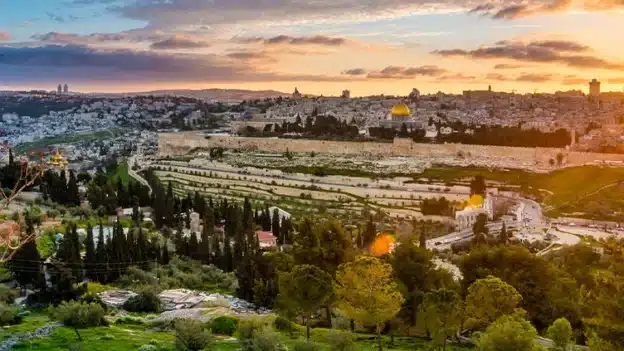
“For behold, I create new heavens and a new earth; and the former things will not be remembered or come to mind…. I will also rejoice in Jerusalem and be glad in My people; and there will no longer be heard in her the voice of weeping and the sound of crying. No longer will there be in it an infant who lives but a few days, or an old man who does not live out his days; for the youth will die at the age of one hundred and the one who does not reach the age of one hundred Will be thought accursed…. The wolf and the lamb will graze together, and the lion will eat straw like the ox; and dust will be the serpent’s food. They will do no evil or harm in all My holy mountain, says the LORD” (Isa 65:17, 19-20, 25).
It has long been taught in universities that Genesis chapter 1 and chapters 2–3 represent two irreconcilable creation accounts, taken from different sources, which should be interpreted separately. Apparently, the Prophet Isaiah cut class on the day this critical approach to the Torah’s strategic introduction was taught (i.e., Genesis 1–3).
Like an acorn, Genesis 3:15 contains a tiny seed of hope—one that embodies the entire story of redemption and from which will grow the tree of eternal life.
Based on Isaiah’s allusions, it is clear that the prophet not only read Genesis 1–3 as a unified story but also as a foundational text for biblical eschatology. The new creation will resemble the original creation, only far better. For in the words of the prophet, “the former things [i.e., Genesis 1] will not be remembered or come to mind” (v. 17). In this new creation, the curse of Genesis 3 will be lifted, death will be reversed (vv. 19–20), and the new Jerusalem, which is the restored garden of Eden (vv. 19–20, 25), will be established forever. That ancient serpent from Genesis 3 will be fully and completely defeated (v. 25).
What can we learn from Isaiah’s interpretation of Genesis 1–3? First, we learn to read the Scriptures, particularly the Torah, as a unified and coherent text. Second, we learn from Isaiah to read the Torah eschatologically. Although Rashi and Tovia Singer insist that Genesis 3:15 is not Messianic, the Prophet Isaiah clearly didn’t agree. Like an acorn, Genesis 3:15 contains a tiny seed of hope—one that embodies the entire story of redemption and from which will grow the tree of eternal life. Finally, Isaiah teaches us how to read biblical history, not merely to understand what once was, but to prepare us for what will be, on a far more glorious and wonderful scale.
“Then I saw a new heaven and a new earth; for the first heaven and the first earth passed away, and there is no longer any sea. And I saw the holy city, new Jerusalem, coming down out of heaven from God, made ready as a bride adorned for her husband. And I heard a loud voice from the throne, saying, “Behold, the tabernacle of God is among men, and He will dwell among them, and they shall be His people, and God Himself will be among them, and He will wipe away every tear from their eyes; and there will no longer be any death; there will no longer be any mourning, or crying, or pain; the first things have passed away” (Rev 21:1-4).