If you want to make up after an argument, to reach out for reconciliation, it’s common to say you’re “extending an olive branch.” It’s a metaphor for making peace. How did this begin? The answer, as for most of life’s questions, can be found in the Bible.
The olive is first mentioned in the very first book of the Bible, and if you know anything about that book (the Bible I mean) you’ll know that the first time a thing is mentioned is extremely important. It’s like a key that unlocks the meaning in the rest of the Scriptures.
Here’s what it says:
And the dove came back to him in the evening, and behold, in her mouth was a freshly plucked olive leaf. So Noah knew that the waters had subsided from the earth. (Genesis 8:11)
It’s from the story of Noah, his family, and the floating zoo. They had waited a painfully long time for the flood waters to subside so they could get out of that ark and start again. After sending out a raven to see if it found somewhere to land, Noah sent out a dove, who returned with an olive branch. It was the sign they were looking for: evidently somewhere there was an olive tree, and life on earth was viable again. God had destroyed the irredeemably violent generation with a flood, but Noah had been different. He and his family were rescued from the destruction and now there was a new start: peace on earth.
When that dove showed up with the olive branch it was almost as if God Himself was offering reconciliation, and saying He wanted peace with mankind. His anger was spent and He promised never to destroy the earth with a flood again. He was now calling a truce, a ceasefire, and offering peace. This is the fundamental meaning of the olive branch, and also the reason why the dove gets roped into the peace symbolism. And the ultimate peace deal is peace with God.
Unilateral disarmament
Although there are two parties in this equation, God and humanity, God’s decisions were unilateral, not collaborative. He decided to destroy an entire generation and all that He made, as is His right as Creator, and then He unilaterally bound Himself to the covenant of peace, hanging a rainbow in the sky to seal the deal and as proof of His promise.
This wasn’t the last time that God unilaterally stepped in to save the broken relationship with mankind, who seem to be perpetually at war with their Creator. At the cross, 2000 years ago, God stepped into His own creation as the man, Yeshua of Nazareth, who then took all of mankind’s sin upon Himself and disposed of it, along with the wrath it deserved. Enmity with God is not our inevitable fate: we can now receive the forgiveness He offers and the Messiah takes all our wrongs away through His sacrifice. All our offenses against God have been paid for and covered by Him.
Each Passover, which so thoroughly foreshadows the whole Messianic event, Jewish people pray the “Oseh Shalom” (peacemaker) prayer:
“May He who makes peace the heavens make peace with us.”
“It is done”, as the Messiah said in His last words on the cross before He gave up His Spirit. He has done it, it is done, and His resurrection proved it was indeed finished. No mere mortal could do that — it could only be done by God Himself. The Prince of Peace made peace in the heavens and peace with us on earth.
Modern Israel and the emblematic olive branches
Unlike the flag of Israel, the emblem of the modern state does not show the Star of David, but the menorah, God’s chosen symbol. The menorah symbolized God’s light and presence in the tabernacle. And two olive branches. It’s reminiscent of Zechariah’s vision of the menorah with two olive trees either side, but we’ll get to that in a minute.
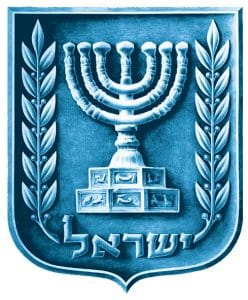
In 1948 the newly reestablished Jewish state invited entries to design the new emblem, but even though 164 people entered hundreds of suggestions, none were chosen. Eventually two brothers, brothers Gavriel and Maxim Shamir, put forward their design. It included the menorah, the name “Israel” written in Hebrew, and the two olive branches either side which provide the olive oil to the menorah alight. The idea was to reference God’s call on Israel to be a “light to the nations” in Isaiah 49.
“It is too light a thing that you should be my servant to raise up the tribes of Jacob and to bring back the preserved of Israel; I will make you as a light for the nations, that my salvation may reach to the end of the earth.” (Isaiah 49:6)
The olive tree is native to the land of Israel, and is treasured by all the peoples of the land, both Jew and Arab. The violation of Palestinian olive groves has been a tension point over the years, particularly as they take so long to grow and become fruitful. Similarly, olives are seen as part and parcel of Jewish life in Israel even back to biblical times:
“For the Lord your God is bringing you into a good land, a land of brooks of water, of fountains and springs, flowing out in the valleys and hills, a land of wheat and barley, of vines and fig trees and pomegranates, a land of olive trees and honey” (Deuteronomy 8:7-8).
Olives are seen as part of Israel’s inheritance in the land, but olive wood carvings, olive oil, and all olive related products are also very Palestinian. Both settlers and Palestinian farmers and artisans alike draw people to their cause by use of the ancient olive trees of the land, inviting foreigners to come and help, to care.
It’s ironic, isn’t it, that the very tree that is supposed to speak of peace is being used to divide people and generate partisan passions. The earth, in the end, is the Lord’s and everything in it. He promises Israel to the 12 tribes repeatedly in the pentateuch and confirms it in the Psalms and the prophets, but in Ezekiel’s end times vision of the Messianic age, when the land is divided between the tribes (with a portion allotted to the Messiah) non-Jewish peoples of the land also inherit the land they live on, just as the sons of Israel (see Ezekiel 47:21).
Part of the idea behind the emblem is Israel extending the olive branch to the neighbors around it, but peace and good relationship cannot be imposed: not by God towards man, and not in the Middle East. Even though God unilaterally made peace possible, it has to be accepted and embraced for peace and reconciliation in relationship. We pray that this will happen, both on the level of the individual, and we look forward to God’s ultimate peace plan for the Middle East when He comes again.
The olive branches: Jews and Gentiles
Olive branch symbolism appears throughout the Bible, but some of the most key passages concern the nation of Israel… and the church. Now to look at that passage in Zechariah, and the vision the prophet had of the heavens. Here’s what he saw:
And the angel who talked with me came again and woke me, like a man who is awakened out of his sleep. And he said to me, “What do you see?” I said, “I see, and behold, a lampstand all of gold, with a bowl on the top of it, and seven lamps on it, with seven lips on each of the lamps that are on the top of it. And there are two olive trees by it, one on the right of the bowl and the other on its left.” (Zechariah 4:1-3)
Quite a bewildering sight for Zechariah. He asked what it all meant, and the angel’s response is apparently so obscure that the prophet asks again, what are the olive trees? Perhaps a clue is in the New Testament, which at that point didn’t exist.
In Romans chapter 11, Paul expounds on the idea of a cultivated olive tree with a wild olive branch grafted into it, as a metaphor for Jews and Gentiles in the Messiah. We are one, we draw from one root, yet one is wild and the other is native. He has a lot of brilliant things to say on the matter, but both the Jewish olive branches and the wild Gentile ones have been forgiven and entered the covenant of peace with God through Yeshua. He who made peace in the heavens has made peace for us.
Both Jewish and Gentile believers are partakers — we have all entered that same covenant. The wild and the cultivated olive branches alike. Now we have peace with God.
This is alluded to also when olive branches are mentioned in Nehemiah, when the returning exiles celebrate the Feast of Tabernacles, designed for both Jews and Gentiles, after 70 years in Babylon. In the original instructions in Leviticus 23 God tells the Israelites to take “the fruit of splendid trees, branches of palm trees and boughs of leafy trees and willows of the brook,” on the first day of the feast and to “rejoice before the Lord your God seven days.” (Leviticus 23:40). Yet in Nehemiah, they change it up a little, perhaps prophetically changing it to include both olive and wild olive:
“Go out to the hills and bring branches of olive, wild olive, myrtle, palm, and other leafy trees to make booths, as it is written.” (Nehemiah 8:15)
The two olive branches appear again and again. Jew and Gentile, natural and grafted in. United, made one, through the covenant of peace in Messiah.
“What are these two olive trees on the right and the left of the lampstand?” Zechariah asks the angel in his vision. “What are these two branches of the olive trees, which are beside the two golden pipes from which the golden oil is poured out?”
He said to me, “Do you not know what these are?” I said, “No, my lord.” Then he said, “These are the two anointed ones who stand by the Lord of the whole earth.” (Zechariah 14:12-14)
Emblem of Israel from Wikimedia Commons
Main picture by Jeremy Perkins on Unsplash